The Myth of the Super Hero
We all love a good hero story. You know the one. A billionaire sweeps in from the sky. They drop a massive check on the table. The problem is solved instantly. The credits roll. We all go home happy.
But real life isn’t a movie.
Reliance on one hero is actually dangerous. What if that hero changes their mind? What if they have a bad financial year? What if they decide they like building rockets better than saving puppies?
The project dies. The impact vanishes.
This is the fragility of the “Big Donor” model. It puts all the power in one pair of hands. It makes the rest of us passive watchers. We sit in the audience and clap. We don’t actually do anything.
That is boring.
We want to build something stronger. We want a system that can survive a bad day. We want impact that doesn’t depend on a single person’s mood.
This is where you come in.
The Power of Being Unnoticed
Imagine you are holding a single euro coin. Look at it. It feels small. It feels insignificant. You might drop it and not even notice. You can buy a cheap coffee, maybe. Or half a chocolate bar.
Alone, that coin is weak.
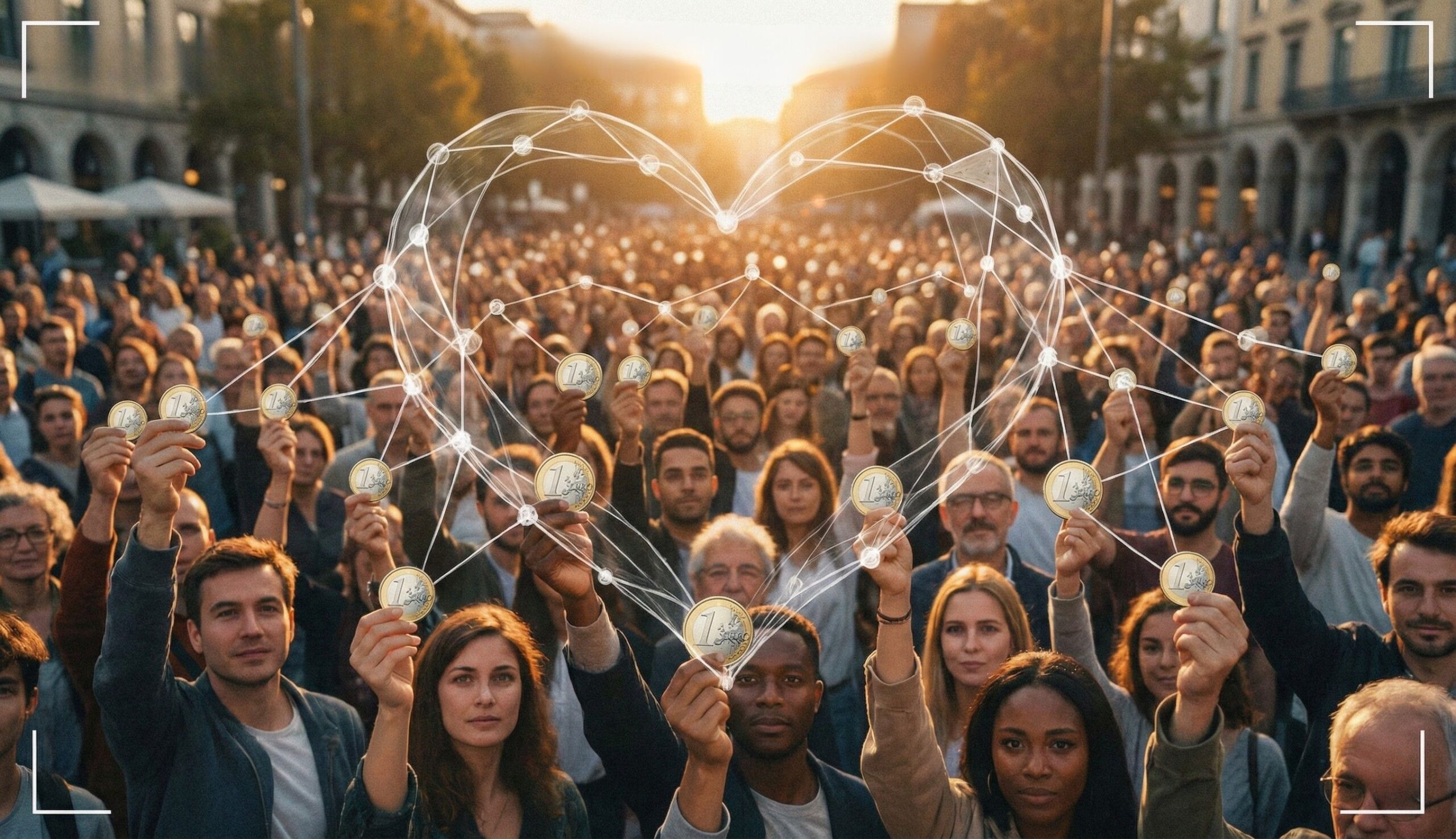
But now, close your eyes. Imagine one million other people holding that exact same coin.
Suddenly, the picture changes.
That is no longer pocket change. That is a massive war chest. That is a force of nature.
This is the core of “Crowd Math.”
When a millionaire gives €1,000,000, it hurts them a little. They feel it. They might want control in return. They might want their name on a building. They might want to tell us how to run things.
When you give €1, it doesn’t hurt you at all. You don’t skip a meal. You don’t stress about your rent. It is frictionless.
This is the crowd’s secret weapon.
Because the burden is so light, you can keep carrying it. You don’t burn out. You don’t feel “donor fatigue.” You just flick a coin and move on.
This creates a safety net that is impossible to break.
If one person leaves our group of a million, we still have 999,999 people. The mission doesn’t even blink. The funds keep flowing. The shelters keep getting help.
We are building a structure with a million pillars.
If you knock one pillar down, the roof stays up. In the old model, there was only one pillar. If that cracked, the whole thing collapsed.
We prefer the million pillars.
Why You Are Better Than a Billionaire
It sounds crazy to say. But in this model, you are actually more valuable than a billionaire.
Here is why.
A billionaire brings money, but they bring their own agenda. They bring complexity.
You bring something else. You bring proof.
When you join One Euro Journey, you are data. You are a signal. You are proving that humans can cooperate.
A single check from a rich person proves nothing about society. It just proves one person has a lot of cash.
But a million tiny transfers? That proves empathy is alive. That proves we can agree on something.
That proof is worth more than the money.
It changes how we see the internet. It changes how we see strangers.
Usually, the internet is a place for fighting. We argue in comments. We block each other. We retreat to our corners.
This project asks you to do the opposite.
It asks you to stand next to someone you don’t know. You don’t need to talk to them. You don’t need to agree on politics. You just need to agree on this one small thing.
That creates a distinct kind of power.
It creates a “Producer” mindset.
You aren’t just a donor anymore. You are a builder. You own a tiny pixel of this massive picture.
And the best part? No one can take that pixel away from you.
The Paralysis of the “Big Ask”
Have you ever walked past a fundraiser on the street?
You know the type. They wear bright vests. They hold clipboards. They have very intense eye contact.
You spot them from a block away.
Your stomach tightens just a little bit.
You suddenly find your phone very interesting. You pretend to be texting. You walk a little faster.
Why do we do this?
Are we bad people? No.
Are we heartless? Absolutely not.
We avoid them because we are afraid of the “Ask.”
We know what is coming.
They don’t just want a high-five. They want a commitment.
They want a monthly subscription. They want your bank details. They want €20 every single month forever.
That feels heavy. That feels like a utility bill.
Your brain instantly starts doing math.
“Can I afford this right now?”
“What if my rent goes up?”
“What if I need that money for an emergency?”
This is called “Analysis Paralysis.”
The decision is too big to make quickly. The friction is too high.
So, you do the only safe thing. You do nothing.
You walk away. You feel a tiny pang of guilt, but you keep walking.
This is the tragedy of traditional charity.
It asks for so much that it often gets nothing.
It turns empathy into stress.
We believe helping shouldn’t feel like a mortgage application.
It should feel light. It should feel easy.
The Psychology of the Cookie
Now, let’s picture a different scene.
You are standing in line at your favorite coffee shop.
You smell the roasted beans. It is a good morning.
You see a jar of cookies on the counter.
They look chewy. They have chocolate chips.
The sign says: “€2.00.”
What happens in your brain?
Do you freeze? Do you call your financial advisor?
Do you panic about your monthly budget?
Of course not.
You just nod. You tap your card. You take the cookie.
You don’t even break your stride.
This is “Coffee Logic.”
Our brains categorize small amounts of money differently than big amounts.
Anything under the price of a coffee is labeled as “safe.”
It is below your pain threshold.
It doesn’t register as a financial risk.
We spend these small amounts all day long.
We buy apps we use once. We buy gum. We upgrade our soda size.
We never feel guilty about these purchases.
We never lie awake at night worrying about that €2 cookie.
So, here is our big question.
Why can’t saving animals feel like buying a cookie?
Why does doing good have to hurt?
Why does it have to be serious and heavy?
We don’t think it does.
We want to hijack that “cookie psychology” for a better cause.
The “All or Nothing” Trap
There is another mental trap we all fall into.
It is the belief that if you can’t do a lot, you shouldn’t do anything.
You see a shelter asking for €5,000 for a surgery.
You look at your bank account. You have €10 to spare.
You think, “My €10 won’t help. It is a drop in the ocean.”
You feel embarrassed to give such a small amount.
It feels almost insulting.
So you close the tab. You give zero.
This is the “All or Nothing” trap.
It kills more dreams than anything else.
We convince ourselves that only “rich people” can make a difference.
We disqualify ourselves before we even try.
The One Euro Journey destroys this trap.
Here, €1 isn’t “too little.” It is the exact right amount.
It is the standard. It is the gold star.
You don’t have to feel shy about it. You don’t have to apologize.
By setting the bar at €1, we make everyone equal.
The student with a part-time job is equal to the CEO.
The “All or Nothing” trap vanishes.
There is no “All.” There is only the “One.”
And everyone can do the “One.”
Speed is the New Currency
Let’s be honest about how we live today.
We live on our phones. We live in the scroll.
We swipe through TikTok. We swipe through Instagram.
Our attention span is short. Very short.
Maybe three seconds. Maybe less.
If you ask me to fill out a long form, I am gone.
If you ask for my home address, I am clicking away.
If you make me create a password, I am definitely leaving.
Friction is the enemy of action.
Traditional donation forms are full of friction.
They feel like homework.
We wanted to build a system that fits your scroll speed.
We wanted “Frictionless Empathy.”
See the video. Like the mission. Click the link. Pay €1. Done.
The whole process takes less time than watching a trailer.
It fits into the tiny cracks of your day.
You can do it while waiting for the bus.
You can do it during a commercial break.
You can do it while the pasta water boils.
It doesn’t demand your whole afternoon.
It just asks for a micro-moment.
And in that moment, you become part of something huge.
The Joy of the Impulse Buy
Marketers have used “impulse buys” on us for decades.
They put candy bars at the checkout line for a reason.
They know you will grab one without thinking.
Usually, impulse buys are bad for us.
They are just clutter or calories.
But what if we flipped the script?
What if we made an “Impulse Buy for Good”?
What if that dopamine hit came from helping a dog, not eating sugar?
That is what a Producer Credit is.
It gives you that instant gratification.
You tap the button. You see your Producer Number.
You feel a little spark of pride.
“I did that. I am Producer #4,502.”
It feels fun. It feels light.
It creates a positive feedback loop in your brain.
You associate helping with feeling good, not feeling drained.
And because it was so easy, you might do it again.
Or you might tell a friend.
“Hey, it’s just a euro. Check this out.”
It spreads because it is light. Heavy things don’t fly.
Light things do.
So go ahead. Treat yourself.
Buy the “empathy cookie.”
It costs one euro. It has zero calories.
And it might just change the world.
The Invitation to Be Small
So, this is our pitch to you.
We are not asking you to be a hero. We are not asking you to save the world alone.
We are asking you to be small.
We are asking you to be one of the million.
We want you to embrace the power of being just a face in the crowd.
Because when that crowd is big enough, it becomes unstoppable.
The math is on our side. The risk is near zero. The reward is massive.
You keep your €999,999. You keep your life savings. You keep your coffee money for tomorrow.
Just give us the 1€ you won’t miss.
Let’s see what happens when a million of us do the same.
Let’s prove the math works.